




Recently, Yating Zhao, a PhD student at the Faculty of Innovation Engineering of Macau University of Science and Technology (MUST), and her supervisor, Associate Professor Yahong Dong, Director of the Macao Institute of Green and Net-Zero Technology, published a research paper entitled “Quantifying environmental burdens in service-based cities: A Regional Organizational Life Cycle Assessment (RO-LCA) of Macao” in Sustainable Cities and Society (Impact Factor: 13.3), a leading international journal in the field of urban sustainability. MUST is the first and sole institutional affiliation of the paper. Yating Zhao is the first author, and Associate Professor Yahong Dong is the corresponding author. PhD student Minghui Liang at the Faculty of Innovation Engineering and Professor Jianqing Li also contributed to the research. The paper is available at: https://doi.org/10.1016/j.scs.2026.108115
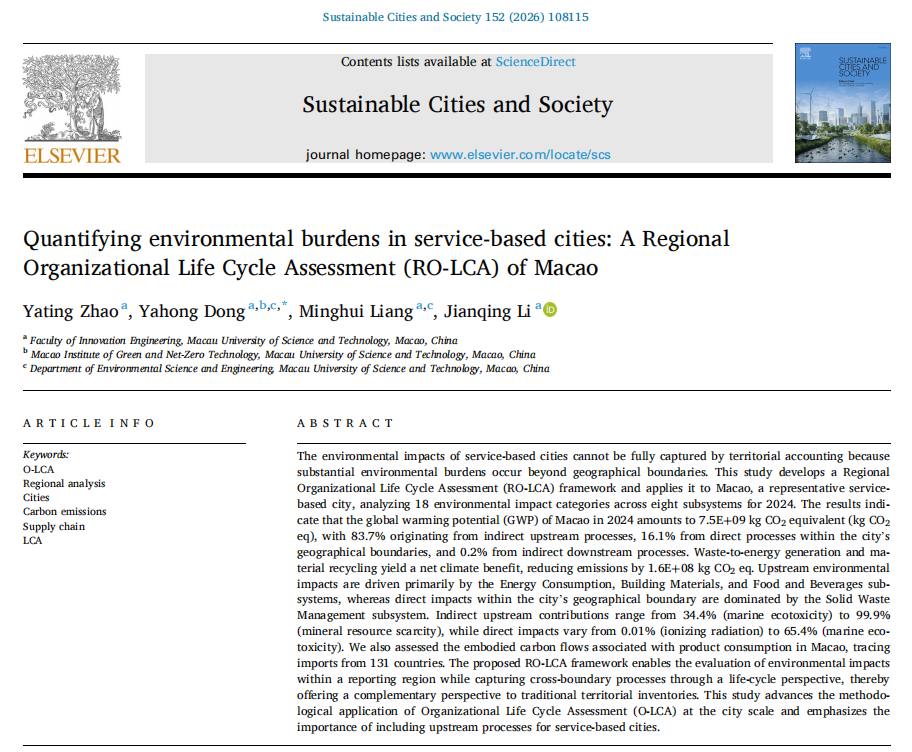
Screenshot of the paper
Traditional urban-scale environmental impact assessments primarily focus on direct emissions within cities’ geographical boundaries, making it difficult to comprehensively capture the indirect environmental impacts associated with urban production and consumption activities along global supply chains. This limitation is particularly pronounced in service-based cities that rely heavily on externally supplied resources. This study extends Organizational Life Cycle Assessment (O-LCA) from the conventional organizational scale to the regional scale and proposes a Regional Organizational Life Cycle Assessment (RO-LCA) framework. By extending beyond conventional geographical boundaries, the framework integrates activities within the region and their associated upstream and downstream processes into a unified environmental assessment framework. Taking Macao as a case study, the research establishes eight subsystems covering energy production, energy consumption, water, building materials, food and beverages, manufacturing, solid waste management, and wastewater treatment to quantify their environmental impacts.
The study reveals that 83.7% of Macao’s life cycle carbon emissions in 2024 originated from indirect upstream processes, with upstream carbon emissions approximately 5.2 times as high as direct carbon emissions within Macao. Of the 18 environmental impact categories assessed, 16 are dominated by upstream environmental impacts, with energy consumption, building materials, and food and beverages being the major contributors. The study further traces embodied carbon flows associated with imported products from 131 countries and regions worldwide, revealing the characteristics of cross-regional transfers of environmental burdens in service-based cities. These findings provide methodological support for formulating urban green and low-carbon development strategies and promoting coordinated cross-regional environmental governance.
In addition to these achievements, Ms. Zhao has continued to conduct systematic research on regional carbon accounting, carbon reduction pathway optimization, and life cycle assessment (LCA), publishing several papers in leading international journals. In 2025, Ms. Zhao, together with her supervisor, Prof. Dong, and other collaborators, published two research papers entitled “Achieving a carbon-negative region through carbon sinks and reduction initiatives: A case study of a coastal bay” and “An integrated scenario-based approach for carbon reduction pathway decision making” in Journal of Environmental Management (Impact Factor: 9.2) and Sustainable Cities and Society (Impact Factor: 13.3), respectively. The former quantified regional carbon emissions in Yanpu Bay, Zhejiang Province, and underwent independent third-party verification, providing scientific support for Yanpu Bay’s recognition as China’s first certified “carbon-negative bay”. The latter proposed a multi-objective optimization approach integrating Stepwise Multidimensional Scenario Analysis (SMSA) and the Entropy Weight Method (EWM), providing decision-making support for the selection of regional carbon reduction pathways. The papers are available at: https://doi.org/10.1016/j.jenvman.2025.127943; https://doi.org/10.1016/j.scs.2025.106584
These research achievements demonstrate MUST’s research capabilities in regional carbon management, LCA, and green and low-carbon development, while also reflecting MUST’s accomplishments in cultivating high-level research talent. Looking ahead, MUST will continue to advance scientific innovation and talent development in green and net-zero technologies, contributing to the green and low-carbon transition and sustainable development of Macao and the Guangdong-Hong Kong-Macao Greater Bay Area.

