





The Fungal Astrobiology and Resilience (FAR) Group at the State Key Laboratory of Lunar and Planetary Sciences (SKLPlanets), Macau University of Science and Technology (MUST) proudly announces its latest achievement: winning the Best Poster Presentation Award at the Asian Mycological Congress (AMC 2025), held in Guangzhou, China, from November 23–26, 2025.
The award-winning poster, “The Impact of Simulated Lunar and Martian Conditions on Pathogenic Fungi,” was presented by Ana Filipa Lenha-Silva, Research Assistant from MUST, with contributions from Gabriel Marques de Barros, PhD candidate from São Paulo State University (UNESP), Brazil; Alireza Armand, Research Assistant from MUST; Célia Fortuna Rodrigues, Professor from Cooperativa de Ensino Superior Politécnico e Universitário (CESPU) and University of Porto, Portugal; Koon Ho Wong, Associate Professor from University of Macau ; and Dr. Marta Filipa Simões, Assistant Professor from MUST.
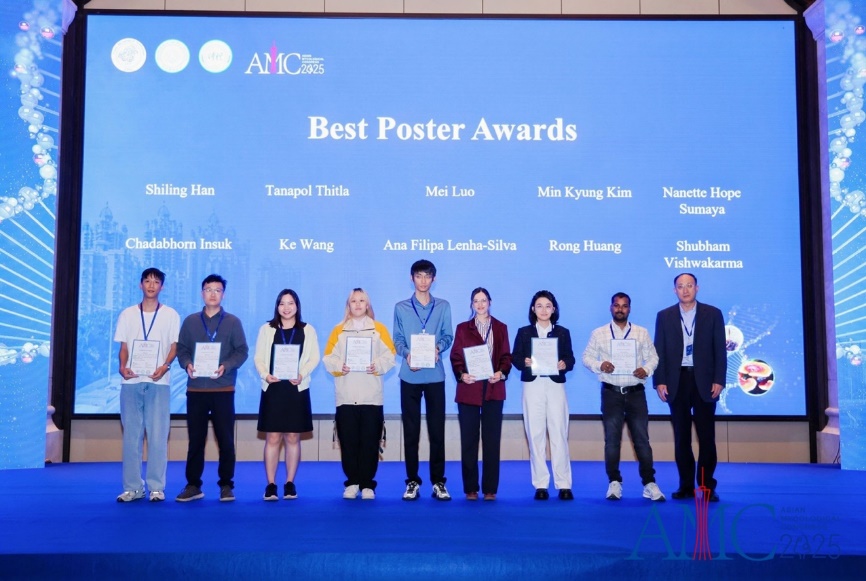
Group photo of the Best poster awards recipients at the AMC2025 conference
This research explores how clinically relevant fungi (Candida albicans, C. parapsilosis, C. tropicalis) and environmental fungi (Aspergillus and Penicillium species) adapt to simulated lunar and Martian gravity and artificial regolith exposure. The study aims to understand morphological plasticity, stress adaptation, and virulence modulation under extraterrestrial analogue conditions, critical for biosafety in crewed space missions and for developing biotechnological applications such as bioremediation and resource utilization in off-Earth habitats.

Ana Filipa Lenha-Silva (in the middle) presenting the award-winning poster to other participants during the AMC 2025 poster session.
“This recognition among more than 170 posters highlights the strength of our team and the importance of astromycology in future space exploration. The FAR Group is committed to advancing knowledge on fungal resilience and its implications for planetary science and human health” said Assistant Professor Marta Filipa Simões, PI and leader of this research.
The AMC Best Poster Award is evaluated based on scientific originality, relevance to mycology and planetary science, clarity of objectives, methodological rigor, and the quality of visual and oral presentation during the poster session. The FAR Group’s poster stood out for its innovative approach to studying fungal adaptation under simulated extraterrestrial conditions, its clear and impactful design, and the effective communication of complex concepts to a diverse audience.
This achievement reflects international collaboration, with partners from Brazil (UNESP), Portugal (CESPU and University of Porto), and Macau (University of Macau). The project was supported by the Science and Technology Development Fund (FDCT), Macau SAR (Projects No. 002/2024/SKL and No. 0033/2024/ITP1).

