




According to the 2025 Nature Index ranking for Space Sciences—published by the internationally renowned research evaluation database Nature Index, which belongs to the same Springer Nature group as the journal Nature—Macau University of Science and Technology (MUST) is ranked 8th in the world, joining the University of California, Berkeley and Johns Hopkins University among the global top 10.
Space science is the scientific discipline that studies cosmic space beyond Earth's atmosphere and the phenomena of celestial bodies, covering branches such as solar physics, space weather, astrodynamics, and planetary science. According to Nature Index analysis of research in this field, space science is undergoing explosive growth—the number of related papers increased by more than 150% between 2023 and 2025. Through sustained research investment and high-quality output in recent years, MUST has established itself among the world's top institutions in this frontier discipline.
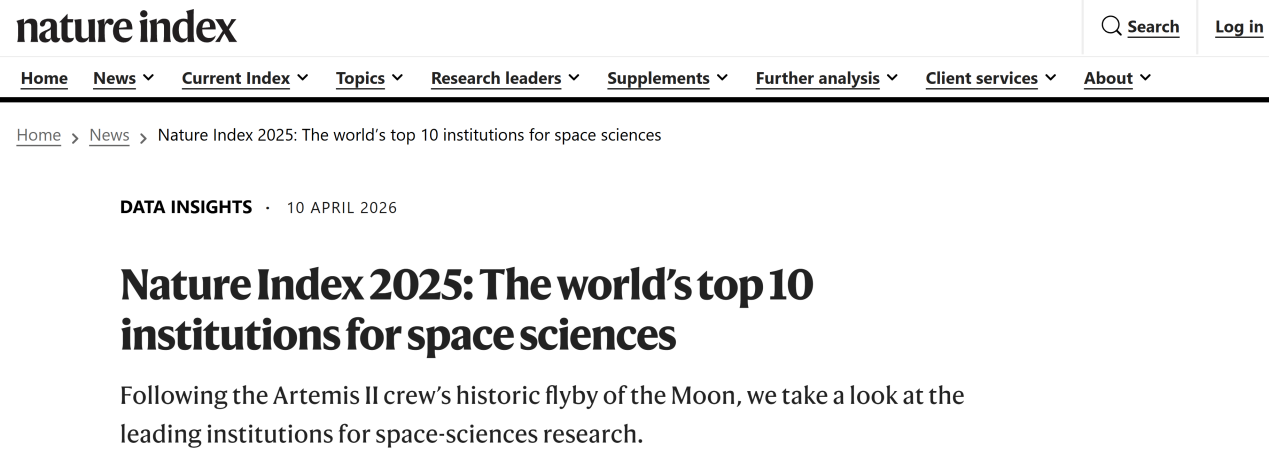
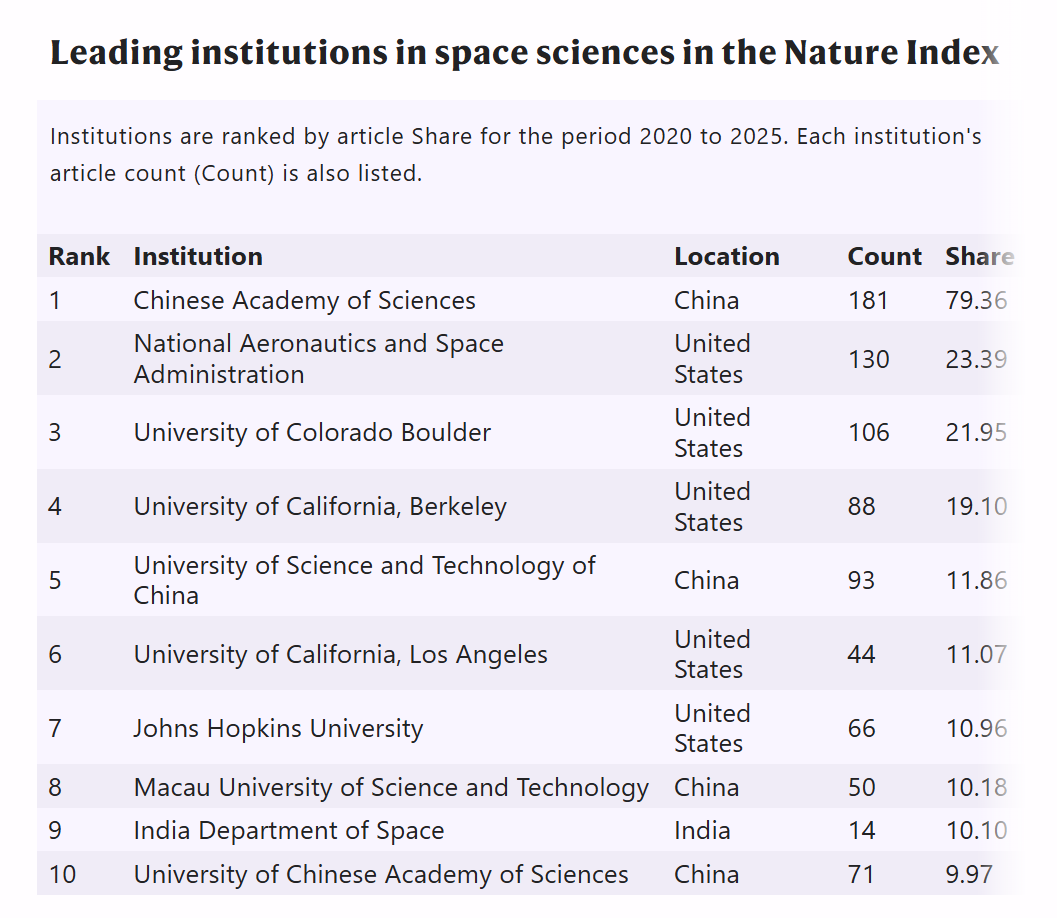
A report page on the Nature Index official website highlights the world's top 10 leading institutions in space science for 2025. Based on publication data spanning 2020 to 2025, MUST secures the 8th position globally.
In this ranking, US institutions occupy five spots and Chinese institutions take four. MUST’s inclusion not only underscores its academic influence within the international space science community but also highlights Macao's pivotal role in China's space exploration research landscape. Its core supporting platform—the State Key Laboratory of Lunar and Planetary Science—is the first state key laboratory in China dedicated to astronomy and planetary science. The lab focuses on three frontier research directions: planetary environment and habitability, planet formation and evolution, and space exploration. Over the past five years, the team has published over 900 research papers, including 18 in Nature, Science, and their respective sub-journals, with an average impact factor of 5.48 for papers published in 2025. The team has participated in every major Chinese deep-space exploration mission to date—from the Chang'e lunar missions to the Tianwen Mars mission—making sustained and significant contributions to China's deep-space program. For these achievements, the team distinguished itself among hundreds of outstanding research teams nationwide and was awarded the Medal of the 4th National Innovation Excellence Award.
In talent development and international impact, Professor Zong Qiugang, Chair Professor and Director of the State Key Laboratory, was awarded the Chandrasekhar Prize in 2025—the highest honor in the field of international plasma physics—becoming the first recipient from China since the prize's inception. In December 2024, President Xi Jinping visited the laboratory in person, commending the team's work and remarking that "your work proves that Macao is fully capable of conducting high-precision, cutting-edge, world-class scientific research."
Looking ahead, the State Key Laboratory of Lunar and Planetary Science has deeply integrated into the forefront of China's deep-space exploration technology innovation chain. It is currently undertaking payload development tasks for a series of major national projects, including the Tianwen-3, Xihe-2, and Chang'e-7 missions, as well as the International Meridian Circle Program (IMCP)—a large-scale international scientific initiative. This global No. 8 ranking in the Nature Index space science field serves not only as an authoritative endorsement of the University's research strength but also injects fresh momentum into MUST's continued pursuit of international excellence in deep-space exploration.
The Nature Index is an open database compiled by Nature Research Intelligence, part of Springer Nature. It tracks research article contributions from institutions and countries across high-quality journals in the natural sciences, health sciences, applied sciences, and social sciences. The journals covered by the Nature Index are selected by independent researchers based on academic reputation, encompassing top-tier multidisciplinary titles. Designed to reflect global high-quality research output and collaboration patterns, the Nature Index has become an internationally recognized benchmark for assessing the research strength of institutions and nations.
Source:
Nature Index 2025: The world’s top 10 institutions for space sciences | News | Nature Index

