




Recently, according to data released by the Institutes of Science and Development of the Chinese Academy of Sciences, Macau University of Science and Technology (MUST) has achieved a significant leap in lunar science research output. During the period 2021–2025, MUST’s publication output in lunar science rose from 13th to 7th worldwide, successfully entering the global top ten. This leap in a core indicator of scientific productivity demonstrates that MUST has established internationally leading academic innovation capacity in this field, laying a solid foundation for playing a more pivotal role in China’s ambitious deep-space exploration blueprint.
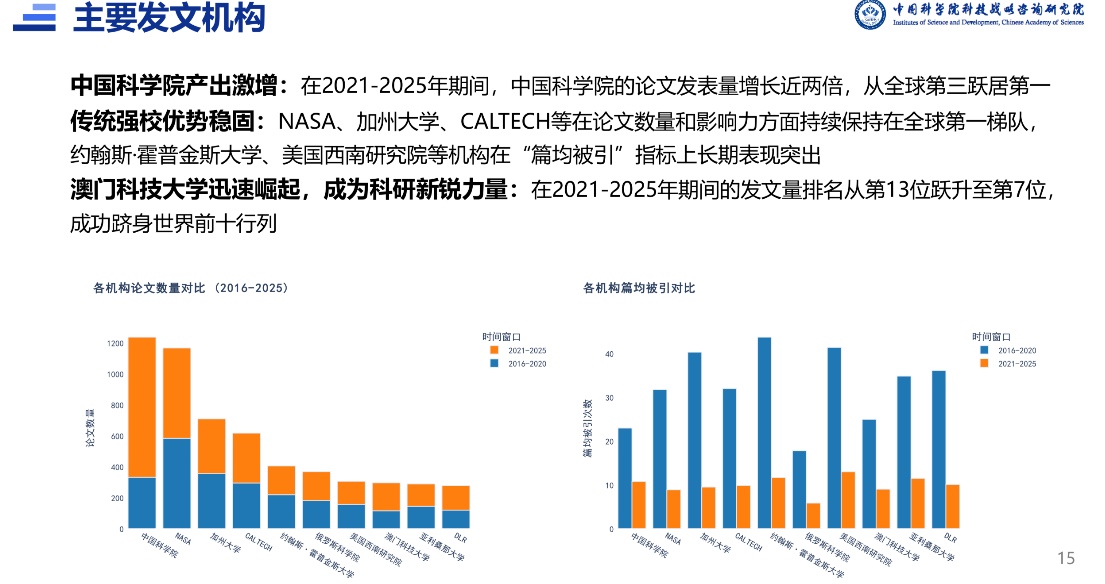
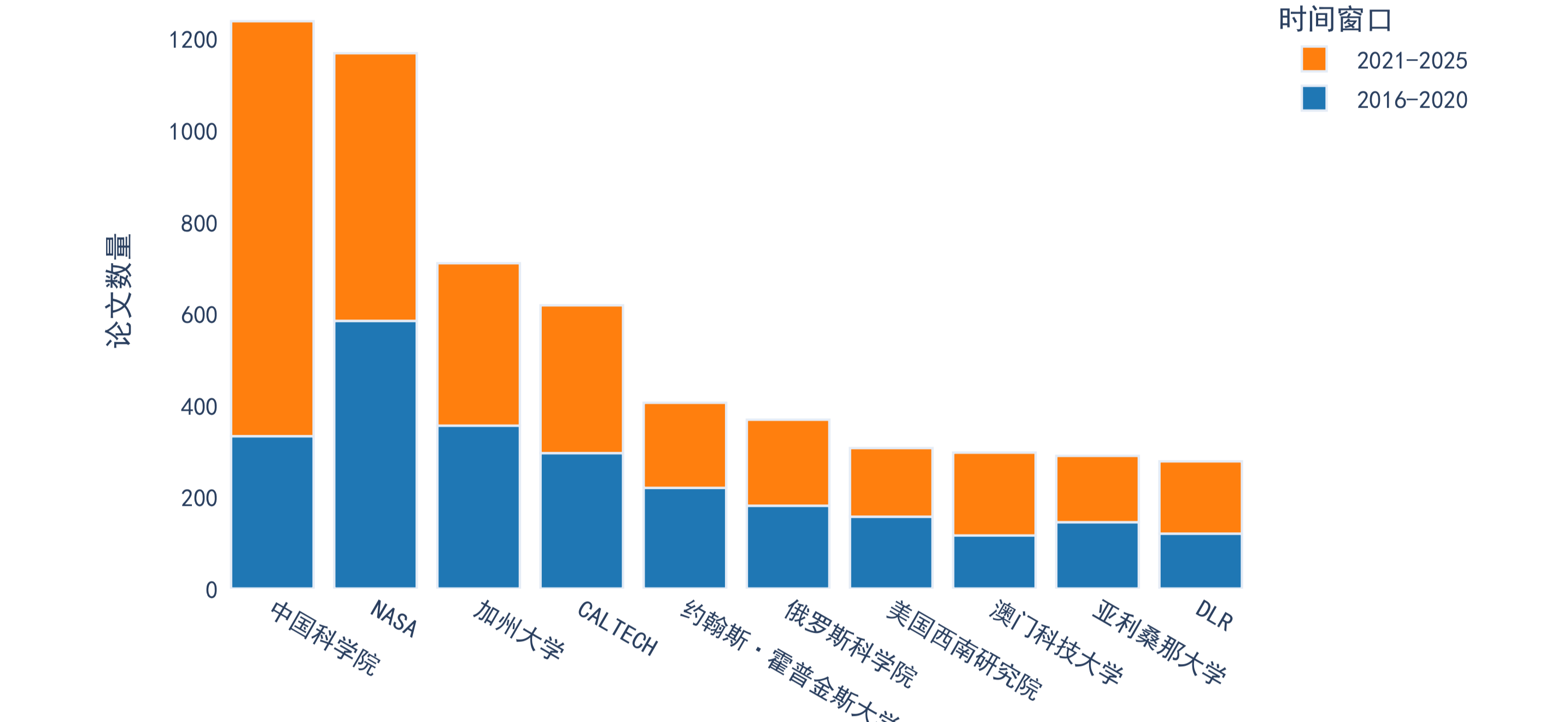
Image source: Institutes of Science and Development, Chinese Academy of Sciences
The figure above illustrates the research output trends of major global institutions in lunar science from 2016 to 2025. Publication data shows that the Chinese Academy of Sciences nearly doubled its output over the past five years (orange bars), rising from third place globally to first; traditional leading institutions (such as NASA and the University of California system) have maintained their leading scale; and MUST climbed markedly from 13th to 7th, entering the world’s top ten. “Average citations per paper” reflect the average impact of publications from each institution.
The core of this achievement is the effort from the State Key Laboratory of Lunar and Planetary Sciences (SKLPlanets) at MUST and its research teams. As China’s first State Key Laboratory in the field of astronomy and planetary sciences, SKLPlanets focuses on and is committed to advancing three frontier research areas: planetary environment and habitability, planetary formation and evolution, and space exploration. With a distinctive and well-defined research layout, its comprehensive strength has gained wide recognition from the domestic and international scientific community.
Over the past decade, the team has published more than 1,170 SCI-indexed papers, including 16 papers in Nature, Science, and their affiliated journals. Research output has been particularly prolific in the past two years, with 375 SCI papers published, 71.5% of which appeared in JCR Q1 journals. In 2025, the average impact factor of these publications reached 5.48. In lunar science, the team has produced a series of frontier results on early lunar evolution and subsurface structures of the lunar far side based on data from the Chang’e missions. Through analyses of Chang’e-returned samples, the team has also obtained observational evidence revealing differences in solar wind irradiation environments between the lunar near side and far side, and has discovered two entirely new lunar minerals—accounting for one quarter of all newly identified lunar minerals worldwide.
From the Chang’e lunar exploration program to the Tianwen Mars missions, the team has been involved in all of China’s major deep-space exploration endeavors. The multi-scale Martian climate model developed by the team provided critical decision support for the successful landing of Tianwen-1, earning the National “Advanced Collective for the First Mars Exploration Mission” award jointly issued by six ministries. This achievement highlights the team’s outstanding capability in translating fundamental research into engineering applications.
One hallmark of the team’s world-class academic standing is the receipt of top international awards by its leading scientists. In 2025, Qiu-Gang Zong, Chair Professor and Director of SKLPlanets, was awarded the Chandrasekhar Prize—one of the highest honors in international plasma physics—becoming the first recipient from China. The team has twice received the First Prize of the Macau Natural Science Awards and was conferred the Medal of Professional Merit by the Macau SAR Government in 2023. On December 19, 2024, President Jinping Xi visited SKLPlanets, highly affirming the team’s work and stating that “Your work proves that Macau is capable of conducting cutting-edge, world-class scientific research.”
The laboratory’s capacity for sustainable development is further demonstrated by its deep involvement in major future national missions. The team has completed a major transition from scientific analysis to payload development, and from collaborative participation to leading responsibilities. At present, the team is undertaking payload development tasks for a series of major upcoming national space missions, becoming an indispensable scientific and technological force:
Tianwen-3 mission: Responsible for developing the Martian molecular and ionic composition analyzer; participating in the development of a laser heterodyne spectrometer.
Chase-2 mission: Leading the development of a medium-energy electron detector and a solar X-ray spectrometer.
Chang’e-7 mission: Participating in the development of a lunar regolith water molecule analyzer and a dust detector.
Chang’e-8 mission: Jointly developing a terrain probing drill for the International Lunar Rover.
International Meridian Circle Program: Responsible for developing Terrestrial Gamma-ray Flash monitoring system.
The Macao SAR Government has also provided dedicated support for payload development related to these missions. Together, these efforts mark MUST’s deep integration into the forefront of China’s deep-space exploration technology innovation chain. Looking ahead, SKLPlanets will continue to align with national strategic needs, fully leverage Macau’s international platform advantages, and contribute distinctive “MUST strength” by reserving scientific ideas, addressing key technologies, and cultivating high-level talent for future deep-space exploration missions, including asteroid exploration and Jupiter system missions.

