






A research team led by Associate Professor Tian Zhong of the Faculty of Medicine (FMD) at Macau University of Science and Technology (MUST), has developed smart active packaging that adjusts its antibacterial and antioxidant functions as the storage environment changes. Published on 9 September 2026 in Advanced Functional Materials (Impact factor 19.9; Q1), the study is titled “Smart Active Packaging with Full-Cycle Adaptability: Light-Enhanced, pH-Switchable Nanozyme Films for Fresh-Cut Salmon Preservation.” Made using discarded yuzu peel, the film extended the shelf life of fresh-cut salmon by at least four days in refrigerated storage trials.
Research published in Advanced Functional Materials
Fresh-cut salmon is highly susceptible to bacterial growth and oxidative spoilage. A key challenge in preservation is that the fish flesh microenvironment continuously shifts over time: initially acidifying due to metabolite accumulation, and later returning to a higher pH as proteins decompose and volatile nitrogenous compounds increase. Adapting packaging materials to these dynamic shifts for continuous protection across storage stages is a crucial task for improving fresh seafood preservation.
To address this challenge, the team converted Yuzu peels into carbon dots and introduced copper ions to synthesize environment-responsive copper-coordinated carbon dots. The core feature of this material is its ability to adjust its function based on the pH level. In the slightly acidic environment of early storage, the copper-coordinated carbon dots exhibit peroxidase-like activity, catalyzing hydrogen peroxide to generate antibacterial hydroxyl radicals that disrupt bacterial cell membranes. As the environment nears neutrality, functional groups on the carbon dots turn into radical scavengers, slowing lipid oxidation. Combined with short-term near-infrared light irradiation, the photothermal and catalytic effects are further boosted, enabling the packaging film to dynamically tune its preservation functions alongside food microenvironment changes.
Beyond outstanding preservation performance, the film offers good UV-shielding and water-retention capabilities. The team also cleverly designed a “peelable-upon-wetting” feature: while normally adhering tightly to the salmon flesh, it peels off effortlessly in one piece when moistened before consumption, making it both convenient and eco-friendly. This research achieves high-value utilization of agricultural waste while offering novel insights for premium seafood preservation and eco-friendly packaging, showcasing FMD’s achievements in the interdisciplinary field of food science and functional materials.
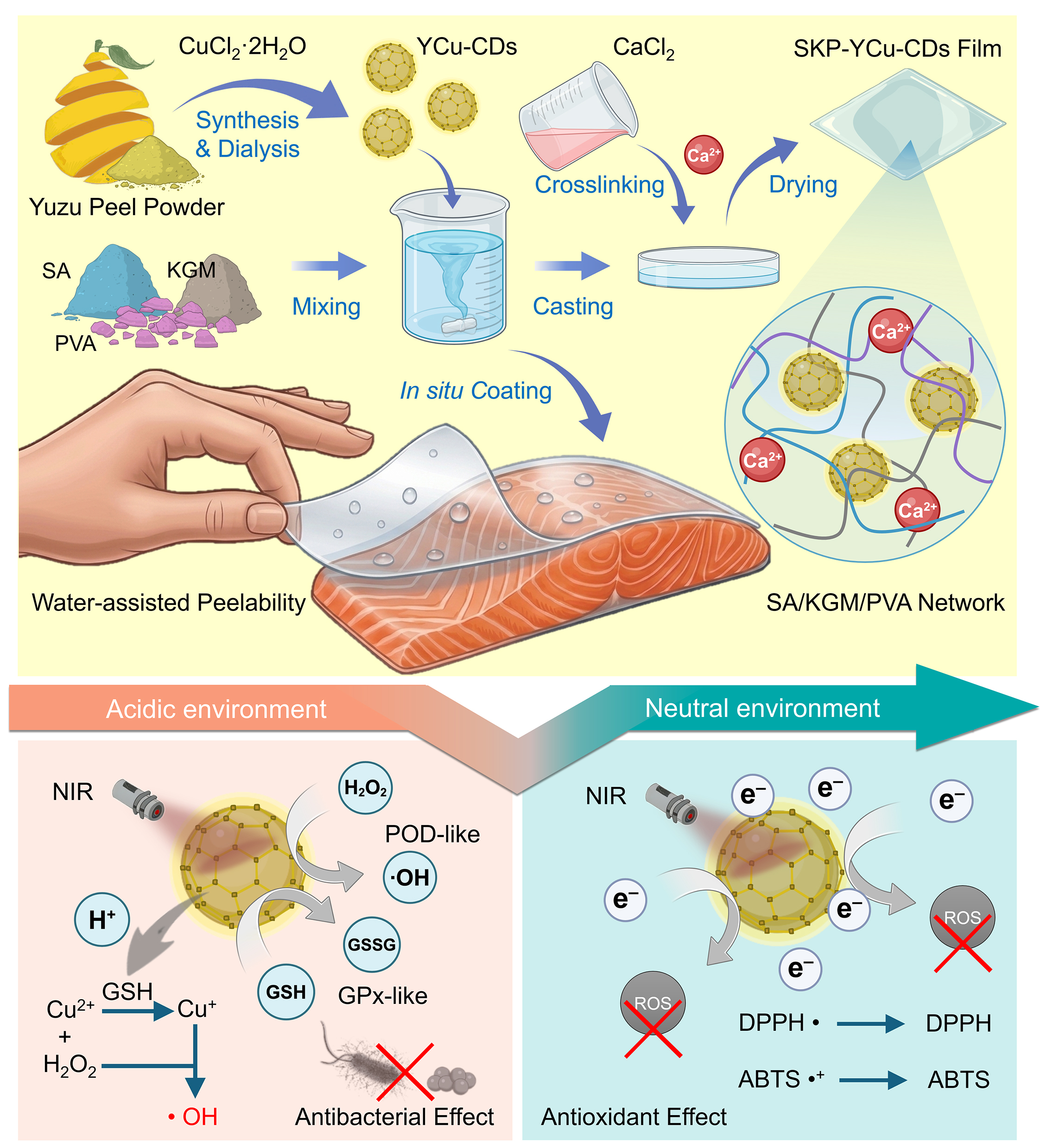
Preparation of the smart active packaging film, its water-assisted peelability, and its pH-responsive antibacterial and antioxidant mechanisms.
The Faculty of Medicine at MUST is the first-listed affiliation. Yuhe Dong, Postdoctoral Fellow from the Faculty of Medicine is the first author, and Associate Professor Tian Zhong is the corresponding author. The research wa`s supported by the Science and Technology Development Fund, Macao SAR (FDCT), under projects 0005/2024/AGJ and 0009/2023/AFJ.
Article link: https://doi.org/10.1002/adfm.78291

