






A research team led by Professor Fei-Yue Wang of the Faculty of Innovation Engineering (FIE) at Macau University of Science and Technology (MUST), working with Anhui University, the Beijing Big Data Center, Sun Yat-sen University, Griffith University and other institutions in China and abroad, has published a paper in the leading international journal Nature Communications. Titled “Embodied cognition-driven interpretable trajectory prediction of autonomous systems,” the study presents an interpretable prediction framework based on embodied cognition for autonomous driving, mobile robotics and other autonomous systems. The framework enables intelligent systems to predict where road users will move next and explain why they may move that way.
The paper was recently selected by the editors of Nature Communications for the Engineering and Infrastructure section of “Editors’ Highlights.” This collection features important recent papers chosen by the journal’s editors for their outstanding scientific value and broad impact. The selection reflects the editorial team’s high regard for the study and further recognition of its contribution.
Trajectory prediction, put simply, uses an object’s past and current motion to estimate where it may move next. For an autonomous vehicle or mobile robot, this capability directly affects its ability to anticipate risks and make safe decisions. Many current AI approaches rely on deep learning to identify patterns in historical data. Although they can achieve high predictive accuracy, the reasoning behind their predictions is often opaque. A model may predict where a pedestrian is likely to go, for example, without explaining why it expects the pedestrian to take that path.
To address this problem, the team developed a prediction method that more closely resembles human cognition. When driving or crossing a road, people do not pay equal attention to everything in view. They prioritize rapidly approaching vehicles, pedestrians who suddenly change direction, and other moving road users whose paths may lead to a conflict. The researchers incorporated this process of focusing on the most relevant participants first into autonomous systems, enabling the model to actively identify road users that warrant closer attention in complex environments.
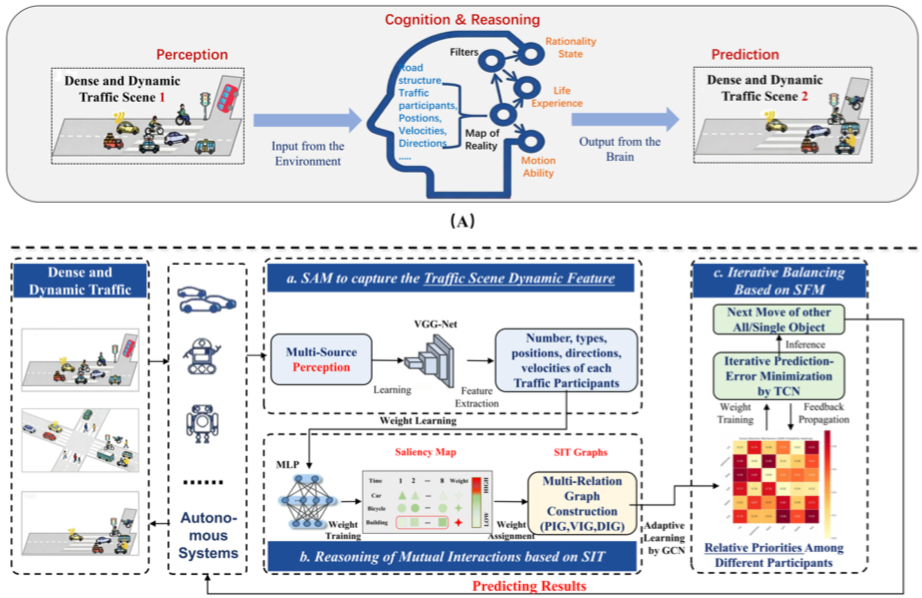
Comparison of human cognition and the embodied cognition prediction framework for autonomous systems.
After identifying the key road users, the system must understand how they influence one another. A nearby pedestrian may pose little risk, while a vehicle farther away but approaching quickly may present a greater threat. The team therefore combines relationships involving position, speed and direction of movement to represent vehicles, pedestrians and cyclists as a dynamic interaction network. This allows the system to assess the potential influence of different participants on one another.
Understanding these relationships is not enough: predictions must also follow the laws of physics. A person cannot change speed and direction instantaneously simply by deciding to avoid an obstacle. Likewise, the future trajectories generated by an autonomous system must account for constraints related to inertia, turning and collision avoidance. The study therefore integrates the modeled social interactions with a physical motion model, continually balancing risk assessment, social interactions and real-world motion constraints. Together, these elements form a complete process for observing the environment, identifying risks, understanding interactions and predicting future motion.
A key contribution of the study is to make parts of AI decision-making visible. Risk attention heatmaps allow researchers to see which road users the model is focusing on at a given moment, while interaction graphs show which vehicles, pedestrians or cyclists have a greater influence on its predictions. When the paths of multiple road users cross or potentially conflict, the corresponding interaction relationships become markedly stronger.
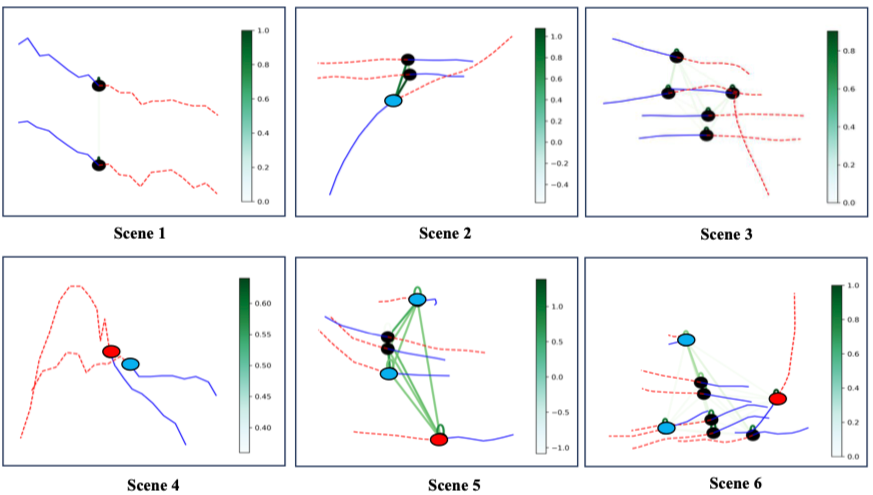
Multi-relation graphs across traffic scenarios, showing interaction strength and potential collision risks.
This means that future autonomous systems must do more than predict accurately. They must also help engineers and users understand what the system has noticed, what informs its judgments and why it behaves as it does. For autonomous driving, service robots and other safety-critical autonomous systems, this ability to visualize, inspect and explain the decision process can help advance AI from conventional black-box prediction toward safer, more trustworthy and interpretable embodied intelligence.
Read the paper: https://www.nature.com/articles/s41467-026-75091-9

